Showing posts with label bikes. Show all posts

Wednesday, June 10, 2009

Safety First: Bike Safety for Commuters


We're back! Thanks for your patience during our move.

We’ve spent a while talking about commuting by bike, and I promised an article on bike safety and advocacy, so here it is.


You all know you need to wear a helmet, protect your eyes with sunglasses, and your skin with sunscreen, but there’s more to bike safety than that when you’re riding among cars.
  1. Signaling: Learn and use hand signals when you’re turning. Yes, they’re dorky, and yes, I hate using them—but sometimes it’s necessary. I’ve never felt the need to use the “stop” signal, however, but I suppose it’s good to know.

  2. Watching out for parked cars: They may be parked, but they’re still dangerous. You’ve probably heard about a cyclist being “doored.” That’s when someone in a parked car opens a door just as a cyclist is approaching, usually causing the cyclist (and sometimes the door) some injury. People can’t seem to understand that they need to look before getting out of a car parked on the street, and for that reason, it’s best to ride at least 3-4 feet away from parked cars. If there’s no bike lane or the shoulder’s small, this means you’ll have to take the nearest lane. And that’s totally fine. Cars can go around you if they want.

  3. Speaking of cars going around you and tight shoulders... If a car gets too close to you, don’t be afraid to give their hood/door, etc. a smack. If a car is driving close enough to you that you can touch it, it’s too close. Let them know.

  4. Watch out for the dreaded right-hook: According to the MassBike website, “A ‘right-hook’ is when a motorist makes an abrupt right turn too close to a bicyclist, causing the cyclist to crash or make an emergency maneuver to avoid crashing.” In Massachusetts, this is illegal, but whether it’s legal or not, cars will still do it. Be especially aware at intersections of cars that may be turning right and keep a safe distance in case they’re not paying attention.

Resources
What the New Bicycle Law Means for you: A Practical Guide

NYC Bicycle Safety Coalition

League of American Bicyclists
Loads of information on bike security, safety, and gear, commuting tips, and more.

Mike’s Bikes: Riding Tips
Even more information and tutorials on pretty much anything you could think of involving bikes. Awesome site, and it’s all free. The “Maintenance and Repair” section is especially helpful.

Books I Recommend (PS, If anyone can tell me how to format so that the following books don't appear vertically, please e-mail me or leave a comment.)


Tune in next week for the final article in our commuting by bike series: bike maintenance for beginners.


Safety First: Bike Safety for CommutersSocialTwist Tell-a-Friend

Thursday, May 14, 2009

DIY Project: Bike Panniers


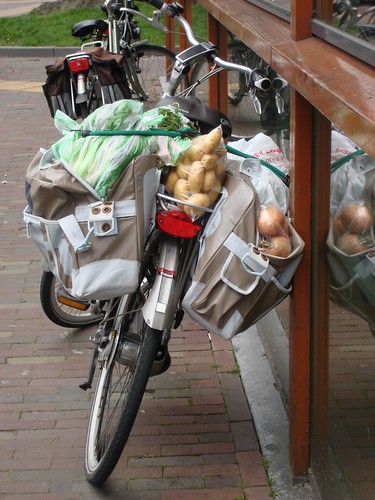
Last week, I wrote about how to make bike baskets. This week, I'm going to give you some options for making your own panniers (on the cheap).

There are a variety of items that can be transformed fairly easily into bike panniers. A fellow Bostonian made some out of 5 gallon water jugs (the kind that are used in water coolers) and was nice enough to share an instructable about it.
Brian Huntley, of crazyguyonabike.com, wrote a great tutorial about how he made some slightly heavier and sturdier ones out of kitty litter buckets.

You could recycle some old messenger bags or backpacks into removable panniers; this instructable shows you how to do it for under $10.

Or you could pick up a couple of old army bags from your local Army Surplus store to make backpack panniers. These can also be made with regular non-army backpacks.

Backpack panniers are by far my favorite because not only are they removable, but you can still use them as backpacks, thereby eliminating the need to switch the items you're carrying from bag to bag when you get off the bike.

If you have any more ideas for homemade bike panniers, let us know by leaving a comment. Feel free to send pictures; we'd love to see your work.

Update: Thanks to Suburban Dollar for including this post in the 179th Festival of Frugality.


DIY Project: Bike PanniersSocialTwist Tell-a-Friend

Friday, May 8, 2009

DIY Project: Bike Baskets


So, if you've been following my recent posts, we've got a little themed section going on about bike commuting, and I thought I'd provide a series of tutorials on how to accessorize your bike on the cheap. Today, the ubiquitous bike basket.

First of all, determine where you want the basket: front, back, or both. If your decide to go with a front basket, make sure to leave enough room so that your brake cords aren't cramped--this can lead to trouble. It's also best to only carry light items in front baskets, as heavy things can make it difficult to steer.

Front baskets: The best baskets for your handlebars are lightweight ones: wire or the traditional woven sort. You don't need to buy an expensive one made especially for bikes; anything with at least one fairly flat side will do. I've even seen repurposed (wicker) bathroom trashcans. You can attach the basket easily by tying the handles or the top edge to your handlebars with a sturdy ribbon, but for more stability, I recommend zip ties. The more you add, the more sturdy your basket will be, and the less pressure each holding point will be supporting. Again, be sure to position your basket so that pressure is not exerted on the brake cables.

Rear baskets: For these, you'll first need to acquire a rear carrier. Check Craigslist for cheap used ones, but make sure they come with all the hardware you'll need to attach it. You have more choices here as far as what kind of baskets you can use. You can still go with woven or wire, but you can also use less traditional bike baskets. I use a plastic milk crate, but you can use pretty much any container that's not solid (so you have holes through which to thread your zip ties). Take a look around the house; you're bound to have some sort of plastic organizer or something that you could use.

Keep in mind that you don't want the basket to be terribly wide because then your mobility will be impaired (i.e. you won't be able to fit between parked cars or through other tight spaces. Also, if you mount and dismount your bike by swinging your leg over the seat (like most people do), you'll need to make sure your basket isn't going to be too high for you to be able to do that comfortably.

To attach the basket, zip ties are your best bet; they hold really well, they're weather proof, and they're lighter than metal hardware. Make sure you used enough ties in various places that your basket can't move at all. Even a little play can be dangerous as it causes repeated stress to the ties.

Holding it all in
If you have an overflowing basket and you're worried about your stuff falling out, bungee cords are a quick, easy way to secure your stuff. Just stretch a cord or two from your handlebars or rear carrier, up and over your basket. If you're carrying smaller items, use your jacket or an old piece of cloth/plastic, etc. to drape across the top and then pull the bungee cords over that.

Weather proofing
The worst thing is to arrive home with a wet basket full of soaked stuff, so if it rains much in your area and you're concerned about getting caught in it, rain proof your basket. You could just drape an old poncho over everything and tuck it in, but for a more stable and permanent solution, you might consider an attached cover. You could fashion a hard lid with some small hinges, but for something lighter weight, I made a flexible cover with a couple old shoelaces and plastic grocery bags. Use some wax paper and an iron to fuse several layers of grocery bag plastic (tutorials here and here) into a sheet large enough to cover the top of your basket, fold the side edges over about an inch and fuse again (for durability), and cut small slits through which to string the shoelaces. Then tie one side of the cover to the side of your basket (tight knots--you won't be untying them), and you're set. Drape the plastic over the basket to find a good fit, and fold over and sew the hinge-side corners so they lay nicely. Secure closed by tying the other shoestrings (loose knots or a bow tie) to the handle area on the other side.

Alternatives to the shoestrings include snaps or buckles (recycled from an old woven belt or the straps of a backpack. These you'll have to sew on, so they'll require a bit more time, but they're more durable than the shoestrings and make for quicker attaching and detaching. For the side that remains attached to the basket, you could use keychain O rings in place of the shoestrings for more durability and ease of movement. Note that woven/wicker baskets themselves aren't very weather proof. They could even mold eventually.

Here's mine. It uses shoestring on the hinge side and a piece of an old belt on the closing side. If I had it to do over, I'd use O rings instead of shoestrings.


Some inspiration:
Front baskets


Rear baskets


Creative baskets


DIY Project: Bike BasketsSocialTwist Tell-a-Friend

Wednesday, April 22, 2009

How to Commute By Bike


Image by denali2001 via Flickr


Getting started
  1. Plan your route. There are several bike route mapping websites out there.1 Or you can buy a foldout bike map; you can get one for Boston here. Planning your route is important not only so you don’t get lost but also because you should know the kind of terrain you’ll need to negotiate before you purchase a bike. If you’ll only be on smooth roads, you won’t want a mountain bike (they’re slower than road bikes). Likewise, road bikes aren’t safe off-road. Hybrids (aka "comfort" bikes) are the best of both worlds, and I highly recommend them. Most of my day-to-day rides are on decent roads, but there are some crappy roads and a few gravel paths that I’m glad to have my hybrid for. The Sports Authority website has some good info about the different bike styles.

    This is my bike. I heart it.
  2. Related to above.... choose a bike! Craigslist will get you one cheap, but you can’t be sure that it’s in great condition. I bought a shitty mountain bike super cheap off Craigslist when I first started riding because I didn’t want to spend a ton on a bike if I decided riding everywhere wasn’t for me. After a few months, though, I sold that one (again on Craigslist) and got a beautiful, new Dutch hybrid (photo coming soon) that I adore. I got my bike at a great price from BikesDirect.com—but I just checked their site and it doesn’t look like they carry the Gazelle anymore. A good bike is vital to a good riding experience, and as much as I hate to spend money, I think it’s worth it to invest in a good bike. It’s also imperative to get the right size bike for your stature. Most bike shops will do a bike “fitting” for free, even if you don’t end up buying from them. Do not, I repeat do not, buy a bike (or anything else for that matter) from Wal-mart, no matter how cheap it is; the stock they carry, at least as far as adult bikes, is notoriously low-quality.

  3. Acquire the necessary accessories. There are tons of bike accessories out there; many of them completely frivolous. These are not:

    • a good helmet –Full-coverage helmets like this one are fine, but a helmet designed especially for cyclists, like this one, is safest. Nashbar.com has nice ones for $20 or you can just get one at your local bike shop. Proper helmet fitting is more important and more complicated than you might think. Almost any bike shop will help you adjust your helmet for the best fit and comfort, no charge. Yes, cycling caps are cute and stylish, but road rash on your face and a cracked skull are not. Wear a helmet over it while you’re riding.

    • a good lock—if you’re riding in a city, you’ll want a U-lock and a cable. The U-lock is for your back tire/frame and you use the cable in conjunction with it to secure your front tire, helmet, seatpost, etc., like this or this. The less space between the U-lock and the bike, the better--it's harder for thieves to get cutters in there. Many will recommend the mini u-locks for this reason, but I've found that a lot of bike racks make it nearly impossible to use those.

      If you’re in a small town or someplace you consider super safe, you could try using just a cable lock, but you’re taking a risk. Those are obviously much easier to cut than a 1” thick steel bar. See this article on C.I.C.L.E. for more locking suggestions.

    • lights—if you’ll be riding at night, you need lights. In addition to reflectors. You need a white headlight, red taillight, and orange reflectors for your spokes and pedals. The color-coding is standard to that people can easily and quickly tell in the dark which direction you’re facing and thereby avoid smooshing you like a pancake. If you’re not going to be riding at night, reflectors will suffice. Most bikes come with sufficient reflectors.

    • travel pump—you may not ever need this, but you’ll be really glad you’re carrying it if you do. ‘Nuff said.

    • rear carrier, baskets, and panniers—if you’ll be carting groceries, pets, or briefcases around, you’ll want to check into acquiring some sort of carrying system.

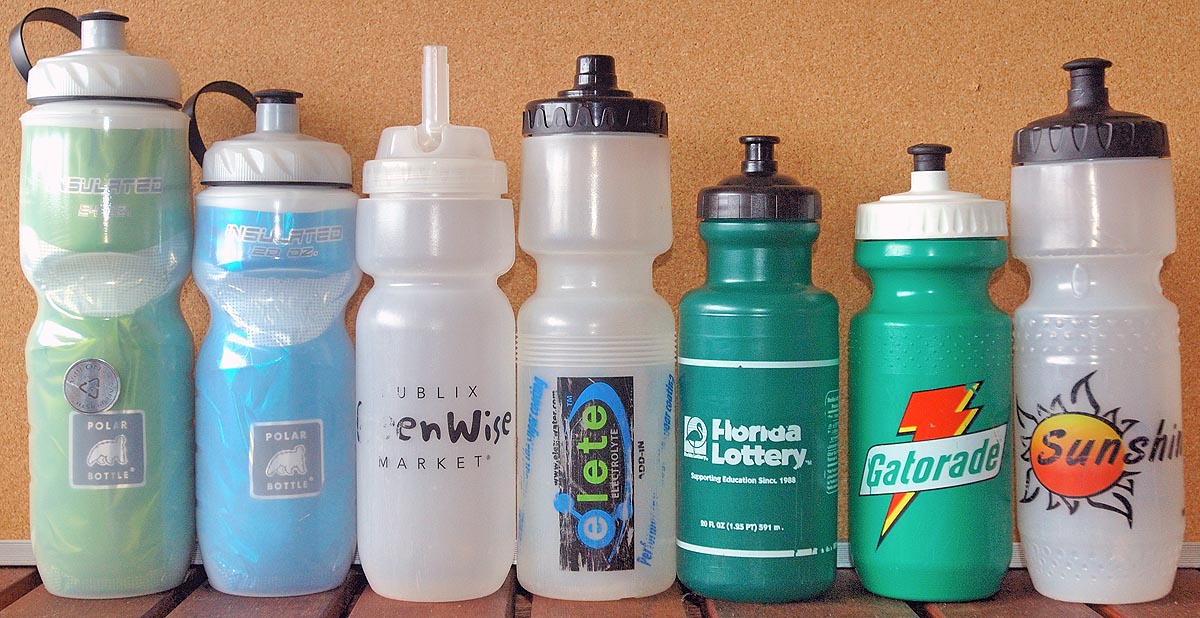
    • water bottle—You probably already have one that’ll work just fine. Stick it in your backpack, basket, or attach it to your bike with a cheap bottle cage. A word of caution: cages take up valuable lock space and often require drilling a hole in your bike frame. Consider this before buying one. If you still decide to go for it, bring your bottle when you buy it to make sure it fits.

    • If you’re game for riding in the rain, a cheap waterproof jacket and a set of fenders will make it much more comfortable. Your tires will kick up a lot of water. No fenders=soaked butt. And don’t be fooled into buying those cheap flat fenders that just attach to your seatpost. They’re useless. If you're hardcore, you might to invest in a pair of rain trousers also.

    • I’d also recommend a full-size pump for at home. It takes a lot of time and muscle to fill a new tube with a travel pump.

    • Keep in mind, a lot of this stuff can be made or improvised for little or no cost. I’ll be posting some DIY bike accessory tutorials in the coming weeks, so check back.

  4. Do a test run on a weekend and time it. This way you’ll know how long it will take you to get to work and you won’t be late. Bring a friend and a picnic and make an outing of it. Don’t forget to check for a safe place near work to lock your bike. Many companies, mine included, provide employee bike racks or garage space. Check with your boss or HR department to see if they offer anything similar. If not, suggest that they think about providing bike parking in the future.

[1] MapMyRide.com, Veloroutes.org, GMap's Pedometer, etc. For a list of city and regional maps, see BikeHacks.com


How to Commute By BikeSocialTwist Tell-a-Friend

Tuesday, April 21, 2009

Why Commute by Bike?


Image by Copenhagen Cycle Chic


You'll be glad to know things have improved since my last post; no more mush muscles, although they’re certainly not what they were. By end of summer, I should be back to normal, I hope.

Now, more on commuting by bike to save $ and the world!

Why commute by bike
I'm including this topic in the blog because it's a great way to save money. But the benefits of biking to work don't stop there—it's great exercise, especially for those of us who spend most of our day at a desk in front of a computer, and you get to be out in the sun and fresh air, skip getting stuck in traffic, and avoid crowded trains and/or buses.

Plus, TAiMH advocates environmental conservation, and biking is a wonderful way to decrease your eco-footprint. You're not consuming natural resources in the form of gasoline and oil, and not creating poisonous, ozone-depleting gases via car exhaust. Also, to be sure not to pollute your work environment (and possibly lose some friends): Bring a change of clothes and a washcloth to use once you arrive.

How Much Will I Save?
It'll differ for everyone, but here's my case:

Since public transport would be my only method of transportation if I didn't bike, I'll check my savings against that. A monthly pass (the cheapest option for a daily train rider) here in Boston costs about $60. That's $720/year.

Biking costs me zero day-to-day, but let's figure in start-up costs and maintenance. Maintenance includes replacement tubes (let's say $10/year, though the place where I bought my bike mails them to me for free) and periodic tune-ups. I usually do my own semi-yearly tune-ups, but if I'm feeling lazy, a little flirting with the repair guy at the local bike shop gets me a free professional tune-up. Don't judge me. You know you do it too. Maintenance total: $10/yr.

Initial costs include the price of my bike ($250) + accessories ($98; see the table below). I didn't acquire all those accessories before I started biking, but let's pretend I did. Initial costs total: $348.

Now, there are still nasty, stormy days when I'll take the train, but if it's just a light rain, I'll ride it. That's what fenders are for. But let's say the odd train ride will cost me $122/year; that's allowing for 3 bad weather days/month (2 train rides daily at $1.70/ride).

Assuming these costs, the first-year savings of commuting by bike comes to around $240. But for every year thereafter, you'd save about $585, since the bike and accessories have already paid themselves off.

But let's get back to me; that's most important, right? These calculations assume you can ride year-round, which I currently cannot (but I will soon!). Right now, I only bike about 7 months out of the year, which means I didn't save anything the first year, but the two years since then, I've saved $340/year over public transport only. Since I'm also helping the environment (and my figure), that's totally worth it to me.

Keep in mind that if you're switching from driving a car to riding your bike, you're going to be saving a hell of a lot more, especially if you get rid of your car completely. Just make sure you've got a back-up plan for bad weather days.


Bike accessories
(These are the ones I use; they'll vary somewhat person-to-person)
accessorycost
helmet$28
U-lock and cable$30
rear carrier$20
lights$15
travel pump$5 used
basket$0 (made it myself from a milk crate and some zip ties)
water bottle, cheap waterproof jacket$0 (got these free at my first Bike Friday 2 yrs ago)
reflective ankle ties, personal lights$0 (got these free at Bike Friday last year)
grand total$98


Have you made the switch to biking? Planning to? Leave a comment and tell us why.


Update: Thanks to Financial Highway for including this post in the Money Hacks Carnival Playoff Edition


Why Commute by Bike?SocialTwist Tell-a-Friend

Tuesday, April 14, 2009

First Bike Commute of the Year!


I was planning to post this on Saturday, but I've been so swamped by the end of the semester/graduation rush that couldn't get to it. I'm posting now only because my brain is too dead to actually work on my thesis. Three more weeks and I'll have my master's and be done with it all! I'm still deciding whether to go for a PhD or not. If I do decide to get my doctorate, it won't be for a while; I need a breather.

So I've been waiting anxiously all year to start commuting by bike again. There are those hardcore cyclists who bike year-round, but I don't know how they do it. Cold and I just don't get on well. Actually, I despise it. (Yes, I know I'm in the wrong city. I'm working on it.)

Last was the first week that the weather here hasn't been below freezing. Naturally it's f*ing freezing again today, but Friday was sunny and beautiful. Those of you who take public transport regularly know that there's nothing worse than being stuck in a noisy bus/train crammed between possibly smelly strangers in lovely spring weather. That was my case Thursday, the first really nice, nearly warm!, day here this year: there I was standing on the train breathing other people's halitosis and whatnot and gazing dejectedly out the grimy windows when a line of cyclists zooms past (yes, my train is ridiculously slow), wind in their hair, sun on their faces. I resolved then that I would ride to work the next day whether it was nice out or not. Then I went out that night and got drunk. Brilliant.

So Friday morning, very tired and slightly hungover, I dusted off my bike, aired up the tires, and headed out into the sunshine. It was great. Not only did I beat the train by 10 minutes, but I had loads of energy the rest of the day.

The way home was a different story. The ride itself was good, but my body decided to pay me back at the end for letting it rot all winter. (I hate to exercise just for the sake of exercising. I really have to get past that.) Apparently, my leg muscles turned to mush over the past few months because when I arrived home and dismounted (as usual, hopping off the side while the bike’s still moving a bit), they couldn’t support me and I sunk like a deflated balloon slow-mo to the ground. No joke. It would have been really embarrassing if anyone besides my senile, non-English-speaking neighbor had seen me. It was the wimpiest fall I’ve ever taken. In fact, I wouldn’t even call it a fall. I felt more like the Wicked Witch of the West when she got water thrown on her. I just sort of melted to the pavement.

Then, naturally, as I’m still sitting sidesaddle on the curb and holding the handlebars of my now-horizontal bike, I picture said melting witch and start laughing, out loud, somewhat insanely. Classic.

The moral of the story here, if you must have one, is that you should not assume your calves of steel survived the long New England winter. In other words, take it easy in the beginning.

More about biking to work/school and other frugal, green ways to commute: here.

Update: Check us out on the Festival of Frugality.

Reblog this post [with Zemanta]


First Bike Commute of the Year!SocialTwist Tell-a-Friend

Got Design?

TAiMH blog design by Belle Étoile Studios.